A looking guide
Burne-Jones mosaics in Rome's St Paul's
A looking guide to the Burne-Jones mosaics in St Paul's Within the Walls: the four panels, how they were made in Venice and where to rest your eyes.
Reserve seats for the tenors ↗Quick answer
St Paul's Within the Walls on Via Nazionale holds four mosaics designed by the Pre-Raphaelite artist Edward Burne-Jones: Christ Enthroned in the Heavenly Jerusalem in the apse, The Annunciation and The Tree of Life over the chancel arches, and a fourth, lower on the apse wall, finished in 1907 by his assistant. They were made in Venice and installed in Rome between 1885 and 1907.
Why a painter designed mosaics
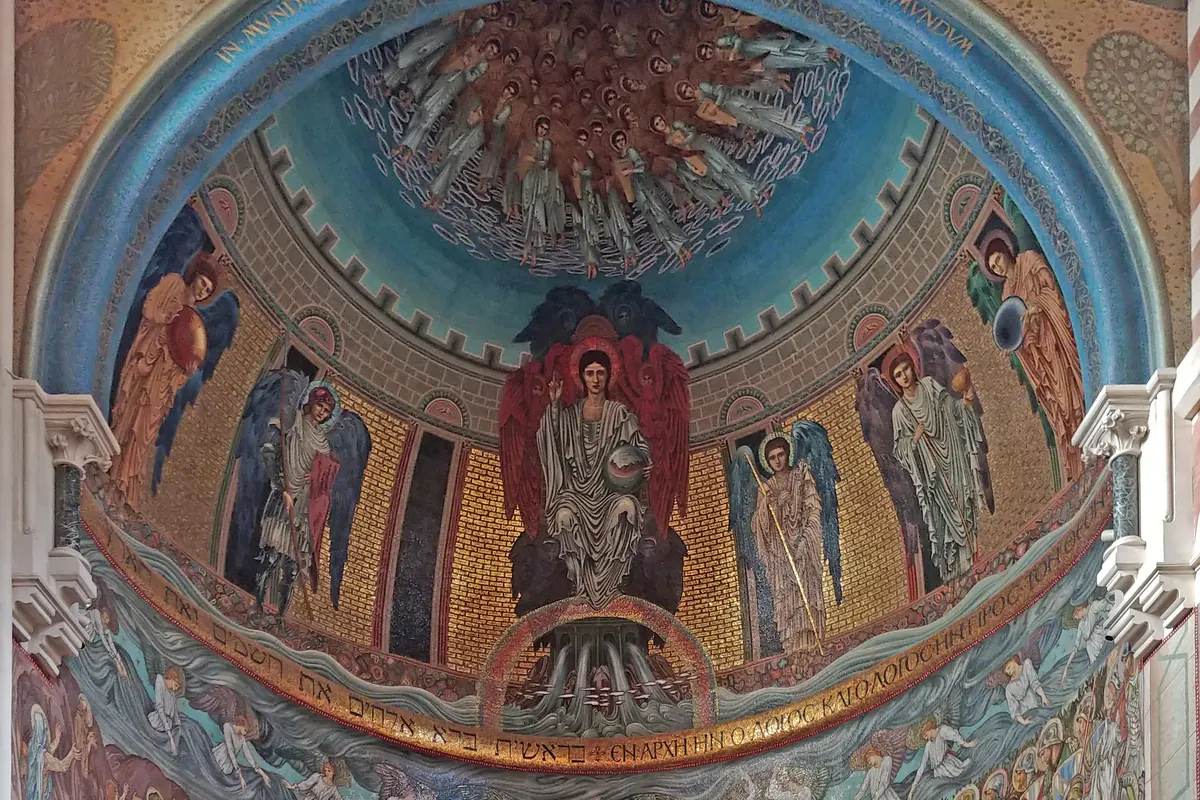
Edward Burne-Jones was a Pre-Raphaelite painter and designer, and he wanted to emulate the mosaics of Ravenna, which he had visited in 1873. When the architect Street approached him in 1881 for the church in Rome, he agreed to design the apse and chancel. The commission was confirmed and expanded by the congregation's rector, Robert J. Nevin, who travelled to England to settle it. The result is the largest body of work Burne-Jones ever made, and it sits in a working church in Rome rather than a gallery in England, which makes it unusual among his surviving works, for its setting and for its scale.
How they were made
Burne-Jones drew full-size cartoons and sent them to Venice with specifications for the colours to be used. The Venice and Murano Glass and Mosaic Company then mounted the tesserae onto the cartoons, and the finished assemblies were installed in the church. The company sent sample tiles to England, and the choice of colours was a collaboration between Burne-Jones and William Morris. Burne-Jones never travelled to Italy to supervise, so his assistant, Thomas Rooke, went in his place.
Where to start looking
Begin with the apse. Its semi-dome shows Christ Enthroned in the Heavenly Jerusalem, completed in 1885, with Christ flanked by archangels and an empty space that represents Lucifer's vacated position. Then raise your eyes to the two mosaics over successive arches of the chancel, The Annunciation and The Tree of Life, both finished in 1894. In the Annunciation, the scene is set in a desert. In The Tree of Life, Christ is shown in the pose of crucifixion, superimposed on a green tree.
The fourth mosaic and the last years
The fourth mosaic sits lower on the apse wall and is titled The Earthly Paradise or The Church Militant. Thomas Rooke finished it in 1907, after Burne-Jones's death in 1898. Its figures include faces modelled on contemporary people, and Turismo Roma notes that St Andrew resembles Abraham Lincoln, St James resembles Giuseppe Garibaldi and St Patrick resembles Ulysses S. Grant.
Other decoration worth a look
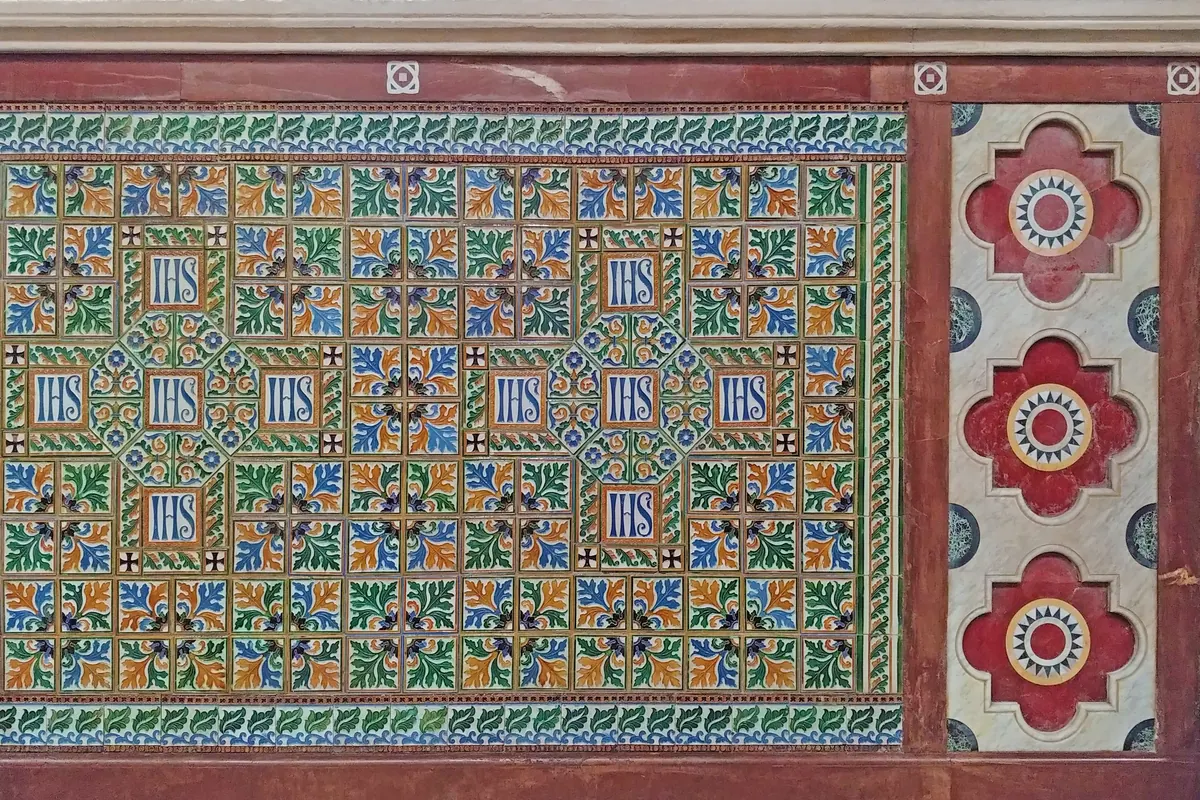
The church has other decoration beyond the mosaics by Burne-Jones. The stained glass in the nave, by the English firm Clayton & Bell, tells the story of St Paul's life. Majolica tiles inside are attributed to William Morris, and the mosaics around the rose window and portal on the façade, from the early twentieth century, are by the American artist George Breck. If you want to look at the church from the pavement, start with the portal and rose window before you go in. The façade mosaics are modern by comparison with the interior and give a quick sense of how the church's decoration grew over several decades.
Looking during a concert
Concerts of opera arias take place inside the church, so the mosaics can share the evening with the music, and the apse is the part of the room that most visitors face. Arrive a little early to look at the apse in good light, then let your eyes rest on it during the quiet moments between pieces. Your confirmation shows the start time. The seating the booking page offers will decide how close you sit to the apse, and the booking page for your date shows what is available.
Who this isn't for
If you want a detailed art-historical tour with a guide, a concert ticket does not provide one. The ticket is for a performance, and the mosaics are part of the setting, not a separate attraction with its own entry. For visiting hours outside concerts, contact the church through the website Turismo Roma lists. And if you prefer ancient Rome, the church will feel late, because its mosaics date from 1885 to 1907.
Frequently asked questions
How many Burne-Jones mosaics are in the church?
Four. The apse and the two chancel panels were completed in 1885 and 1894, and the fourth was finished in 1907 by Thomas Rooke.
Where were the mosaics made?
In Venice, by the Venice and Murano Glass and Mosaic Company, from cartoons by Burne-Jones.
Sources